Give AI Agents a Clock
Hibernation infrastructure for agents that work across time
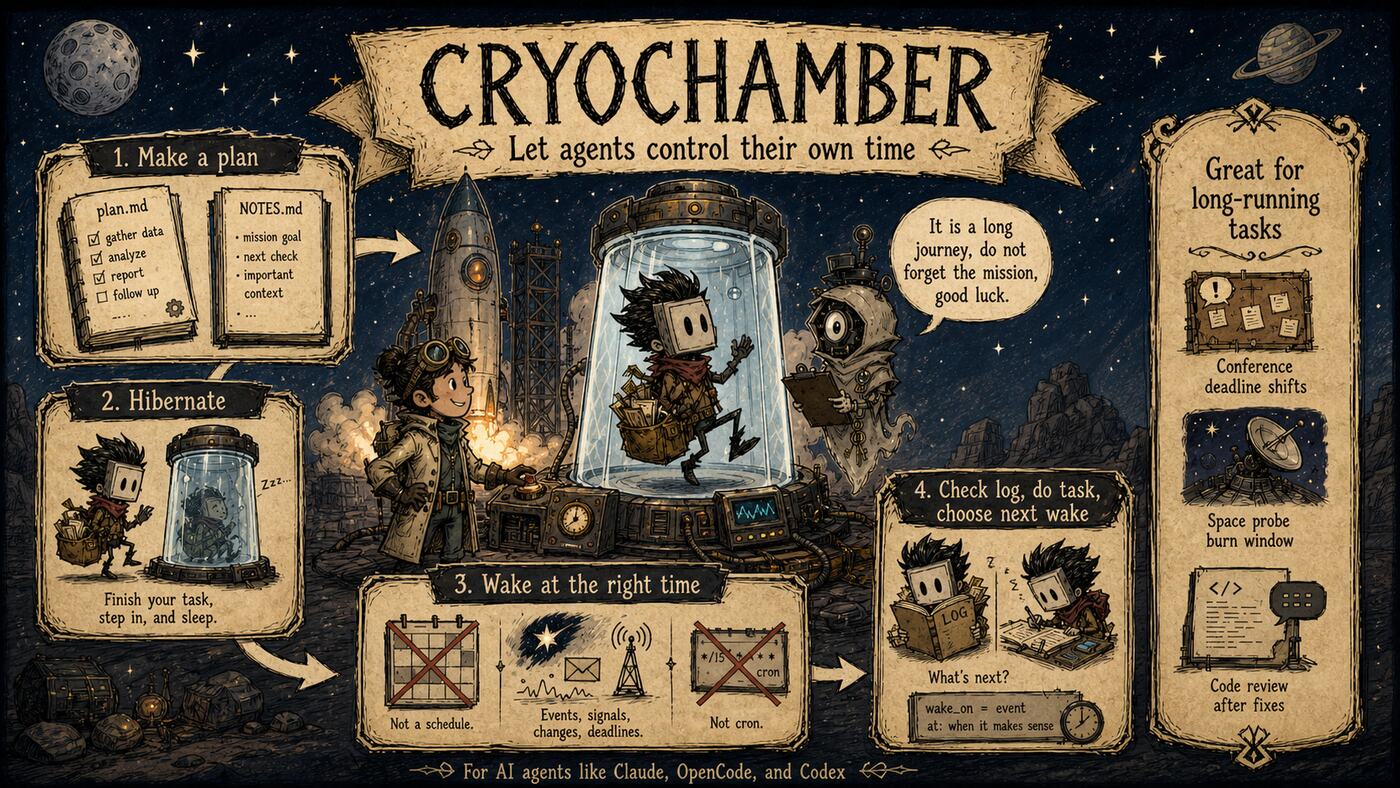
I kept running into a small problem with long-running AI agents: most of the time, there is nothing for them to do.
They are waiting for a human reply, a deadline, a threshold, or some external change. But many agent systems still treat waiting as activity. They wake the model on a fixed heartbeat, ask whether anything changed, and pay for another model turn even when the answer is no.
Cryochamber is my attempt at a different primitive: let the agent finish one session, decide when the next session is worth running, and then hibernate.
The metaphor is borrowed from interstellar travel. If humans ever travel to a planet outside the solar system, the hard part is not only moving fast. It is surviving the long middle of the journey: preserving the mission, sleeping through the empty years, and waking at the moments that matter. Cryochamber applies the same idea to AI agents. The agent should not burn energy just to remain present. It should remember the mission, sleep through idle time, and wake when there is useful work to do.
Waiting Is Not Work
A heartbeat is useful when you want continuous presence. OpenClaw, for example, describes heartbeat as periodic agent turns in the main session, with defaults like 30 minutes or 1 hour. Its docs also discuss cost controls, because heartbeats are full agent turns and shorter intervals burn more tokens. That is the right shape for some products. Sometimes you want an assistant to feel present.
But for sparse work, heartbeat feels like the wrong default. If nothing changed, I do not want the model to think. I want a daemon to wait.
This matters because idle model turns are still model turns. OpenAI prices API usage by input and output tokens, and its conversation-state docs note that previous input tokens in a response chain are still billed as input tokens. Prompt caching can reduce repeated-prefix cost, but it does not make idle turns free.
The cheapest idle agent turn is the one you do not run.
A Disk Monitor That Decides When To Wake
The example that made this concrete for me was a small chamber called
disk-size-warn.
Its job is ordinary: check my disk usage and warn me before things get painful.
The plan says to inspect / and /System/Volumes/Data, report when usage is
high, and never modify the system without permission.
The interesting part is the wake policy:
- under 80%: sleep for 7 days
- 80-85%: sleep for 3 days
- 85-90%: check again tomorrow
- over 90%: check again in 12 hours
That is not complicated, but it changes the control loop. The schedule is not fixed outside the agent. The agent observes the current situation, decides which case it is in, sends a report if needed, schedules the next wake, and hibernates.
When the disk was at 87%, the chamber checked daily and started looking for
cleanup targets. When I challenged the first diagnosis, I sent it a message; the
daemon woke the agent immediately. The agent inspected deeper directories,
updated its notes, and eventually found a major hidden consumer: ~/.julia was
using about 70 GB.
A cron job could run df every day. A heartbeat agent could ask itself every
half hour whether the disk needs attention. But this felt different: the model
was invoked only when the situation justified another session.
The Plan Is A Policy, Not A Schedule
In Cryochamber, plan.md is closer to a policy document than a script.
For disk-size-warn, the plan does not say “run every day forever.” It says
what matters: disk pressure, cleanup suggestions, user permission, and the next
wake interval for each severity level.
At the end of a session, the agent turns that policy into a concrete TODO:
check disk usage and report if near full
at 2026-05-04T21:30
The daemon owns that waiting state. It can sleep through the idle period without calling the model. If the TODO becomes due, it starts another session. If I send a message, it wakes immediately. If the machine was suspended and the wake is late, the next prompt includes a delayed-wake notice so the agent can account for that.
That separation is the core design: the agent owns judgment; the daemon owns waiting.
Cron, Heartbeat, And Hibernation
Cron gives the operator a clock. It is simple and reliable, but the schedule is fixed outside the agent.
Heartbeat gives the agent a pulse. It can keep an assistant present, but “nothing happened” can still become another model turn.
Hermes Agent has a broader automation model: cron jobs, skills, persistent
goals, and fresh agent sessions. Its cron docs include a wakeAgent: false
pre-check path for frequent polls, specifically to avoid paying for
zero-content agent turns when nothing changed. That is a good optimization.
Cryochamber starts from the other side. Hibernation is the primitive. The agent does one bounded session of work, decides when the next session is worth running, and exits.
cron:      the operator decides when the agent runs
heartbeat: the system keeps giving the agent turns
cryo:      the agent decides when the next turn is worth running
Some tasks should be cron jobs. Some assistants need heartbeat. But for adaptive long-running work, I want the default state to be sleep.
What The Daemon Guarantees
Once the model is allowed to disappear between sessions, the boring parts become important.
Cryochamber keeps those parts outside the model. The daemon remembers the next
wake time, watches the inbox, starts the agent process, records the session log,
and enforces the lifecycle. The agent communicates through cryo-agent: send a
message, receive inbox messages, add a TODO, hibernate.
This gives the system a few practical guarantees. Every session leaves a visible message, even if the agent exits too early. Every inbox message that the agent receives gets either an agent reply or a daemon fallback. TODOs are claimed when they are due, and if a session crashes, the daemon reschedules the claimed work with backoff instead of silently dropping it.
The model can be clever when it is awake. The daemon should be dependable while the model is gone.
Agents That Work Across Time
The point of Cryochamber is not that every agent needs a daemon. It is that some agent work naturally spans time.
For disk-size-warn, the question is not only “what should the agent do?” It is
also “when is the next useful moment to think?” The answer depends on the
situation: disk pressure, trend, urgency, and whether I have asked a question.
That is the clock I want to give agents.
Not continuous presence. Not fixed polling. A small loop:
wake -> observe -> act -> choose next wake -> hibernateIf the world changes sooner, wake sooner. If nothing changes, spend nothing. If the situation becomes urgent, escalate. If the work is done for now, disappear.
Cryochamber is my attempt to make that loop ordinary.